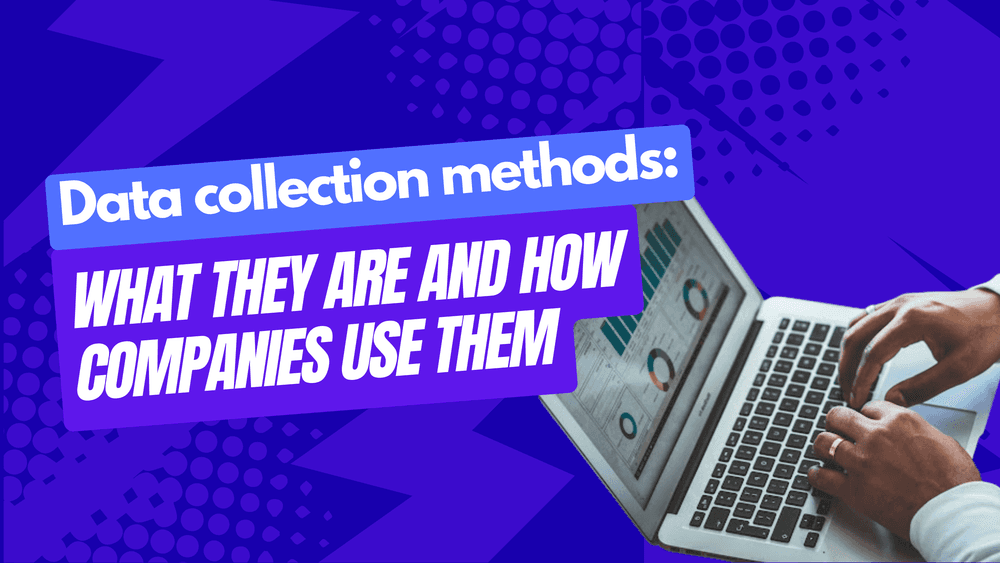
Data collection is the process of gathering information in an organized way in order to answer a question or make a decision. Collection methods are the approaches used to obtain it: surveys, interviews, observation, document analysis, web scraping. Each method relies on a specific instrument.
If you're researching this topic for a thesis, you'll find the classic methods and their instruments here. But this guide goes a step further: it shows how a company applies them, which digital methods have been added over the last few years, and how to choose the right one for what you need to know.
Types of data: primary, secondary, quantitative and qualitative
Before picking a method it helps to be clear on what kind of data you need. There are two basic classifications.
By origin:
- Primary data: you collect it yourself, directly from the source, for a specific objective. A survey of your customers, for example.
- Secondary data: it already exists because somebody else collected it for a different purpose. Official statistics, market reports or information published on websites, for example.
By nature:
- Quantitative data: expressed in numbers and measurable. Price, number of sales, age, delivery time.
- Qualitative data: describes qualities, opinions or motives. Why a customer chose a competitor, what they think of your service, how they use a product.
Plenty of business decisions need both: the numbers tell you what is happening, and qualitative data helps you understand why.
Data collection methods and instruments
A common confusion is mixing up method and instrument. The method is the approach (a survey, for example). The instrument is the concrete tool used to apply it (the questionnaire).
| Method | Instrument | Type of data | Typical business use |
|---|---|---|---|
| Survey | Questionnaire | Quantitative (and some qualitative) | Customer satisfaction, NPS, market research |
| Interview | Interview guide | Qualitative | Product discovery, interviews with key accounts |
| Focus group | Discussion guide | Qualitative | Testing concepts, messaging, packaging |
| Observation | Observation sheet or checklist | Qualitative and quantitative | In-store experience, usability testing |
| Document analysis | Record sheet | Secondary | Industry reports, regulation, public tenders |
| Experiment | Experimental design, A/B test | Quantitative | Pricing, web pages, campaigns |
| Internal records | CRM, ERP, analytics | Quantitative | Sales, inventory, user behavior |
| Web scraping | Scraper or extraction service | Secondary, quantitative and textual | Competitor prices, catalogs, reviews, listings |
| APIs and open data | API connection, dataset download | Secondary | Financial data, public statistics, weather |
| Sensors and IoT | Measurement devices | Quantitative | Logistics, manufacturing, energy consumption |
Let's go through each one and how it applies in a company.
Traditional methods applied to business
Surveys
This is the most used method for collecting data from many people at once. It's applied with a questionnaire of closed questions (fixed options) and, sometimes, a few open ones.
In the company: satisfaction surveys after a purchase, NPS measurement (how likely people are to recommend you), pricing studies or internal employee engagement polls.
Advantage: it scales well and results can be compared over time.Limit: people answer what they say they do, not always what they actually do. And response rates tend to be low.
Interviews
Guided conversations with one person. They can be structured (fixed questions), semi-structured (a guide with room for follow-ups) or open.
In the company: interviews with customers to understand why they buy or cancel, with industry experts, or with users before designing a product.
Advantage: depth. Motives emerge that a survey never captures.Limit: they're slow, expensive, and their results can't be generalized to a whole population.
Focus groups
They bring together a small group (generally 6 to 10 people) to discuss a topic guided by a moderator.
In the company: testing a brand name, packaging, a campaign or a product concept before launching it.
Observation
This means recording what happens without asking. It can be in person or digital.
In the company: watching how customers move through a store, how they use an app (session recordings, heatmaps) or how a process runs on the factory floor.
Advantage: it shows actual behavior, not reported behavior.
Document analysis
The review of documents that already exist: reports, statistics, regulation, industry publications.
In the company: analyzing market reports, the financial statements of publicly traded competitors, public tenders or regulatory changes.
Experiments and A/B tests
One variable is changed under controlled conditions and the effect is measured. In digital, the most common version is the A/B test: show two versions of something to different groups and compare results.
In the company: testing two prices, two versions of a landing page or two email subject lines.
Digital data collection methods
Traditional methods are still useful, but today a large share of the data a company uses is collected automatically.
Internal records
Everything the company already generates in its own systems: sales in the ERP, interactions in the CRM, support tickets, website behavior in Google Analytics.
It's the cheapest source and often the least exploited. The challenge is usually that the information is spread across several systems that don't talk to each other.
Web scraping
Web scraping is the automated extraction of information published on websites. A program crawls the pages, takes the data you care about and organizes it into a database.
It's the fastest-growing method for collecting secondary data at scale, because a large share of the information about a market lives on the web: competitor prices and catalogs, real estate listings, job postings, customer reviews, data from public portals.
In the company: daily price monitoring, building prospect lists, reputation tracking, or collecting data from government sites. If you want concrete ideas, see what data your company can extract.
Advantage: volume, frequency and data you can't get any other way.Limit: sites change and block, so scrapers need maintenance. And you have to respect each source's legal conditions.
APIs and open data
Some platforms offer an API, an official way to request their data in an organized format. There are also open data portals run by governments and international organizations.
Advantage: structured, stable data.Limit: not every source has an API, many have query limits or high costs, and sometimes they don't include every field visible on the web.
Sensors and IoT
Devices that continuously measure physical variables: temperature, location, consumption, vibration.
In the company: fleet tracking, cold chain monitoring, predictive maintenance on machines.
If you want to go deeper into the digital variants, we go through them in 6 types of data extraction.
How to choose the right data collection method
No method is better than another. There's one that's more appropriate for each question. These five questions help you decide:
- What do you want to know? If it's what is happening or how much, you need quantitative data (surveys, records, scraping). If it's why, qualitative (interviews, focus groups).
- Does the data already exist? Before designing a survey, check whether the answer is in your own systems or published on the web. It's usually faster and cheaper.
- How often do you need it? An annual survey is enough for measuring satisfaction. To track competitor prices you need daily data, and that's only viable with automation.
- What volume do you need? Ten interviews can be done by hand. Ten thousand products from a catalog can't.
- What resources do you have? Time, budget and technical capacity define what you can do internally and what's better delegated.
In practice, companies combine methods. A retail chain might cross-reference its own sales (records), competitor prices (web scraping) and customer opinions (surveys) to decide its pricing strategy.
Common mistakes when collecting data
- Collecting without a clear question. Gathering data "just in case" fills databases nobody uses.
- Biased samples. Surveying only your most loyal customers produces results that are far too optimistic.
- Leading questions. "How satisfied are you with our excellent service?" measures nothing.
- Not documenting the source or the date. Without that, the data can't be verified or refreshed later.
- Neglecting cleanup. Duplicated, incomplete or inconsistently formatted data ruins any analysis that follows.
- Ignoring the legal framework. If you collect personal data, the applicable data protection law comes into play. We explain it in data extraction laws.
From collection to analysis
Collecting is the first step, not the last. Cleaning, analysis and interpretation come next. That's where data mining comes in, looking for patterns inside the information gathered. We explain it in what data mining is and how companies use it.
If you want to see the full flow, from source to ready-to-use data, you can read the steps of data extraction.
When it makes sense to outsource data collection
Traditional methods, like surveys or interviews, usually stay inside the company or go to a market research consultancy. With digital methods at scale the picture is different: maintaining scrapers, integrating sources and validating millions of records takes a dedicated technical team.
Outsourcing usually makes sense when:
- Your team spends too many hours copying data by hand.
- The information is scattered across many sources and nobody unifies it.
- You need external data frequently (daily or weekly) and have nobody to maintain the extraction.
- The data feeds critical decisions and you can't afford errors or interruptions.
At AUTOScraping we handle this with our data collection service: we gather information from multiple sources, validate it and integrate it into the systems you already use. We've run more than 350 projects across more than 15 industries. If what you need is recurring, automated extraction, you can also look at how to automate web scraping.
Frequently asked questions about data collection methods
What are the data collection methods?
The traditional methods are the survey, the interview, the focus group, observation, document analysis and the experiment. The digital ones include analysis of internal records, web scraping, the use of APIs and open data, and sensors or IoT devices.
What's the difference between a data collection method and an instrument?
The method is the approach used to obtain the information, for example a survey. The instrument is the concrete tool used to apply it, for example the questionnaire. An interview uses an interview guide, and observation uses an observation sheet or checklist.
What are the qualitative data collection methods?
The main ones are the interview, the focus group, observation and the analysis of documents or text, such as customer reviews and comments.
What are the quantitative data collection methods?
The most used are the survey with closed questions, the experiment, analysis of internal records, web scraping of structured data (such as prices or quantities) and sensor measurements.
What are primary and secondary data?
Primary data is collected by whoever is going to use it, directly from the source and for a specific objective. Secondary data already exists because another person or organization collected it for a different purpose, such as official statistics or information published on websites.
Is web scraping a data collection method?
Yes. It's a method for automatically collecting secondary data published on websites. It makes it possible to gather large volumes of information, such as prices, catalogs or reviews, and to refresh it frequently.
Is your team losing hours gathering data? We collect, validate and integrate it for you. Explore the data collection service.