In 2026, both web scraping and data mining play crucial roles in extracting valuable insights from vast amounts of data. However, they serve different purposes and are applied in distinct contexts. Understanding the differences between these two techniques is essential for businesses looking to leverage data effectively for competitive advantage, market research, and strategic decision-making.
This comprehensive guide explores both methodologies, their applications, strengths, and limitations to help you determine which approach best suits your business needs.
What is Web Scraping and How Does It Work?
Web scraping is the automated process of extracting data from websites using specialized software tools or scripts. It involves programmatically accessing web pages, parsing the HTML content, and collecting specific information for storage, analysis, or integration into other systems.
How Web Scraping Works:
- Sending HTTP Requests: The scraping tool sends requests to target websites to retrieve web pages.
- Receiving HTML Response: The web server returns HTML content of the requested page.
- Parsing HTML: The tool analyzes the HTML structure to locate desired data elements.
- Extracting Data: Specific information is extracted based on predefined rules or patterns.
- Storing Data: Extracted data is saved in structured formats like CSV, JSON, or databases.
- Processing: Data may undergo cleaning, transformation, and validation before use.
Common Web Scraping Techniques:
- HTML Parsing: Using libraries like Beautiful Soup or lxml to navigate HTML structures
- DOM Parsing: Extracting data from the Document Object Model
- XPath and CSS Selectors: Targeting specific elements within web pages
- API Integration: Accessing structured data through official APIs when available
- Headless Browsers: Using tools like Selenium or Puppeteer for JavaScript-heavy sites
- Regular Expressions: Pattern matching for extracting specific text formats
Key Characteristics:
- Source-Specific: Targets specific websites or web-based data sources
- Real-Time Data: Can provide current, up-to-date information
- Structured Output: Produces organized data in usable formats
- Automation: Eliminates manual data collection efforts
- Scalability: Can handle large-scale data extraction from multiple sources
Understanding Data Mining and Its Applications
Data mining is the process of discovering patterns, correlations, and insights from large datasets using statistical analysis, machine learning algorithms, and computational techniques. Unlike web scraping, which focuses on data collection, data mining emphasizes analyzing existing data to extract meaningful knowledge.
Data Mining Process:
- Data Collection: Gathering data from various sources (databases, data warehouses, etc.)
- Data Cleaning: Removing inconsistencies, errors, and irrelevant information
- Data Integration: Combining data from multiple sources into a unified dataset
- Data Selection: Identifying relevant data subsets for analysis
- Data Transformation: Converting data into appropriate formats for mining
- Pattern Discovery: Applying algorithms to identify patterns and relationships
- Pattern Evaluation: Assessing the significance and usefulness of discovered patterns
- Knowledge Presentation: Visualizing and communicating findings to stakeholders
Common Data Mining Techniques:
- Classification: Categorizing data into predefined classes or groups
- Clustering: Grouping similar data points without predefined categories
- Association Rule Learning: Discovering relationships between variables
- Regression Analysis: Predicting numerical values based on historical data
- Anomaly Detection: Identifying unusual patterns or outliers
- Sequential Pattern Mining: Finding temporal patterns in time-series data
- Text Mining: Extracting insights from unstructured text data
Applications of Data Mining:
- Customer Segmentation: Grouping customers based on behavior and characteristics
- Fraud Detection: Identifying suspicious activities and transactions
- Market Basket Analysis: Understanding product purchase patterns
- Predictive Maintenance: Anticipating equipment failures before they occur
- Credit Scoring: Assessing creditworthiness of loan applicants
- Churn Prediction: Identifying customers likely to discontinue service
- Recommendation Systems: Suggesting products based on user preferences
Web Scraping vs Data Mining: Which is Right for Your Business Needs?
The choice between web scraping and data mining depends on your specific business objectives, data sources, and analytical requirements.
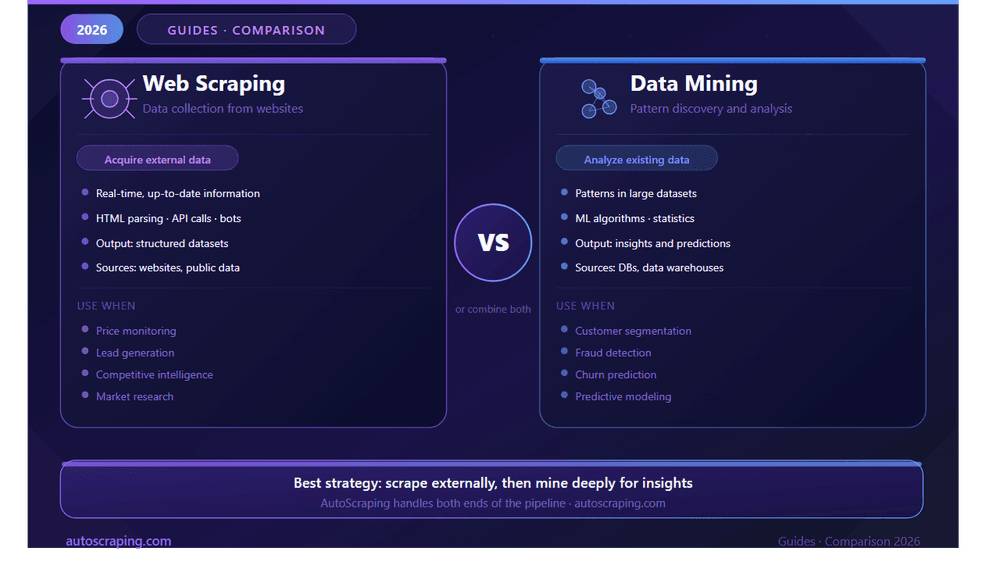
Comparison Table:
| Aspect | Web Scraping | Data Mining |
|---|---|---|
| Primary Purpose | Data collection and extraction | Pattern discovery and analysis |
| Data Source | Websites and web-based platforms | Existing databases and datasets |
| Focus | Acquiring external data | Analyzing internal or collected data |
| Output | Structured datasets ready for analysis | Insights, patterns, and predictions |
| Techniques | HTML parsing, API calls, browser automation | Statistical analysis, machine learning algorithms |
| Timing | Real-time or scheduled data collection | Analysis of historical or static datasets |
| Skills Required | Programming, web technologies knowledge | Statistics, machine learning, domain expertise |
| Legal Considerations | Must respect website terms of service, robots.txt | Data privacy regulations, consent requirements |
| Use Cases | Price monitoring, lead generation, market research | Customer segmentation, fraud detection, forecasting |
When to Use Web Scraping:
- You need external data not available through APIs or databases
- Real-time or frequently updated information is required
- Competitive intelligence from publicly available sources
- Aggregating data from multiple websites
- Market research requiring diverse data sources
- Price monitoring across e-commerce platforms
When to Use Data Mining:
- You have large existing datasets requiring analysis
- Need to discover hidden patterns and relationships
- Predictive modeling and forecasting requirements
- Customer behavior analysis from transaction data
- Fraud detection and risk assessment
- Optimizing business processes based on historical data
Combined Approach:
Many organizations benefit from using both techniques in sequence:
- Web Scraping: Collect external data from websites and online sources
- Data Mining: Analyze the collected data along with internal datasets to extract insights
This integrated approach enables comprehensive market intelligence and data-driven decision-making.
Applications
Web Scraping Applications:
E-commerce and Retail:
- Price comparison and monitoring across competitors
- Product catalog aggregation for marketplaces
- Customer review collection and sentiment analysis
- Inventory tracking and availability monitoring
Market Research:
- Gathering consumer opinions from forums and social media
- Tracking industry trends and news
- Competitor analysis and benchmarking
- Identifying emerging market opportunities
Real Estate:
- Property listing aggregation from multiple platforms
- Price trends and market analysis
- Neighborhood and amenities information
- Investment opportunity identification
Financial Services:
- Stock market data collection
- News and sentiment analysis for trading
- Economic indicator tracking
- Alternative data sources for investment research
Travel and Hospitality:
- Hotel and flight price monitoring
- Review aggregation for reputation management
- Availability tracking across booking platforms
- Competitive rate analysis
Data Mining Applications:
Customer Relationship Management:
- Customer segmentation for targeted marketing
- Churn prediction and retention strategies
- Lifetime value calculation
- Personalized recommendation engines
Healthcare:
- Disease diagnosis and prognosis prediction
- Treatment effectiveness analysis
- Patient risk stratification
- Drug discovery and development
Banking and Finance:
- Credit risk assessment
- Fraud detection and prevention
- Anti-money laundering compliance
- Investment portfolio optimization
Telecommunications:
- Network optimization and capacity planning
- Customer churn prediction
- Service quality monitoring
- Usage pattern analysis
Manufacturing:
- Predictive maintenance scheduling
- Quality control and defect detection
- Supply chain optimization
- Production process improvement
Data Extraction Services in Business Environments
Modern businesses require robust data extraction capabilities to remain competitive. Professional data extraction services offer several advantages:
Service Comparison:
| Aspect | In-House Development | Managed Services | Hybrid Approach |
|---|---|---|---|
| Initial Cost | High (development, infrastructure) | Low to medium (subscription-based) | Medium (combines both) |
| Ongoing Costs | Medium (maintenance, salaries) | Predictable (monthly/annual fees) | Variable (depends on mix) |
| Expertise Required | High (technical team needed) | Low (handled by provider) | Medium (some internal capability) |
| Customization | Complete control and flexibility | Limited to service capabilities | Flexible based on needs |
| Scalability | Requires infrastructure investment | Easily scalable on demand | Scalable with planning |
| Time to Deploy | Long (development cycle) | Fast (ready-to-use solutions) | Medium (depends on components) |
| Maintenance | Internal team responsibility | Provider handles updates | Shared responsibility |
| Data Security | Full internal control | Depends on provider security | Mixed security model |
Benefits of Professional Services:
- Expertise Access: Leverage specialized knowledge without building internal capability
- Cost Efficiency: Avoid upfront infrastructure and development costs
- Faster Implementation: Quick deployment compared to custom development
- Scalability: Easily adjust capacity based on changing needs
- Compliance: Providers ensure legal and ethical data collection
- Maintenance: Ongoing updates and support included
- Focus on Core Business: Free internal resources for strategic activities
Choosing the Right Approach:
Choose In-House Development When:
- Data extraction is a core competency
- Highly specialized or proprietary requirements
- Complete control over processes is essential
- Long-term cost optimization is prioritized
- Sufficient technical expertise is available
Choose Managed Services When:
- Quick implementation is needed
- Limited technical expertise internally
- Variable or unpredictable data needs
- Focus on core business activities is critical
- Compliance and legal expertise is required
Choose Hybrid Approach When:
- Some internal capability exists but needs augmentation
- Different data sources require different approaches
- Balancing cost and control is important
- Gradual capability building is desired
- Flexibility to adjust over time is valued
FAQs: Web Scraping vs Data Mining
What is the difference between data mining and web mining?
Data mining analyzes existing datasets to discover patterns and insights using statistical and machine learning techniques. Web mining is a broader concept that encompasses web scraping (data collection from websites), web content mining (analyzing web content), web structure mining (analyzing website structures), and web usage mining (analyzing user behavior patterns).
Is web scraping the same as data scraping?
Web scraping specifically refers to extracting data from websites and web-based sources. Data scraping is a broader term that includes web scraping but also encompasses extracting data from various other sources like databases, APIs, documents, and applications. Web scraping is a subset of data scraping focused on web-based data sources.
What is the difference between ETL and web scraping?
ETL (Extract, Transform, Load) is a comprehensive data integration process that extracts data from various sources, transforms it into a consistent format, and loads it into a target system (typically a data warehouse). Web scraping is specifically the extraction component focused on gathering data from websites. ETL is a broader process that can include web scraping as one of its extraction methods.
What is the difference between SQL and data scraping?
SQL (Structured Query Language) is a language for querying and managing data in relational databases. It retrieves data already stored in structured databases. Data scraping extracts data from external sources (websites, documents, etc.) that aren't in a database format. SQL works with existing structured data, while scraping acquires unstructured or semi-structured data from external sources.
Conclusion
Both web scraping and data mining are powerful techniques that serve different but complementary purposes in the modern data ecosystem. Web scraping excels at acquiring external data from web sources, enabling businesses to gather competitive intelligence, market insights, and real-time information. Data mining, on the other hand, focuses on analyzing existing datasets to uncover patterns, predict outcomes, and generate actionable insights.
The most successful data strategies often combine both approaches: using web scraping to collect diverse external data sources and data mining to analyze this information alongside internal datasets. By understanding the strengths and appropriate applications of each technique, businesses can build comprehensive data capabilities that drive informed decision-making and competitive advantage.
Whether you choose to build in-house capabilities, partner with specialized service providers, or adopt a hybrid approach, the key is aligning your data extraction and analysis methods with your specific business objectives, technical capabilities, and resource constraints. As data continues to be a critical business asset in 2026 and beyond, mastering these techniques will be essential for organizations seeking to thrive in increasingly competitive markets.