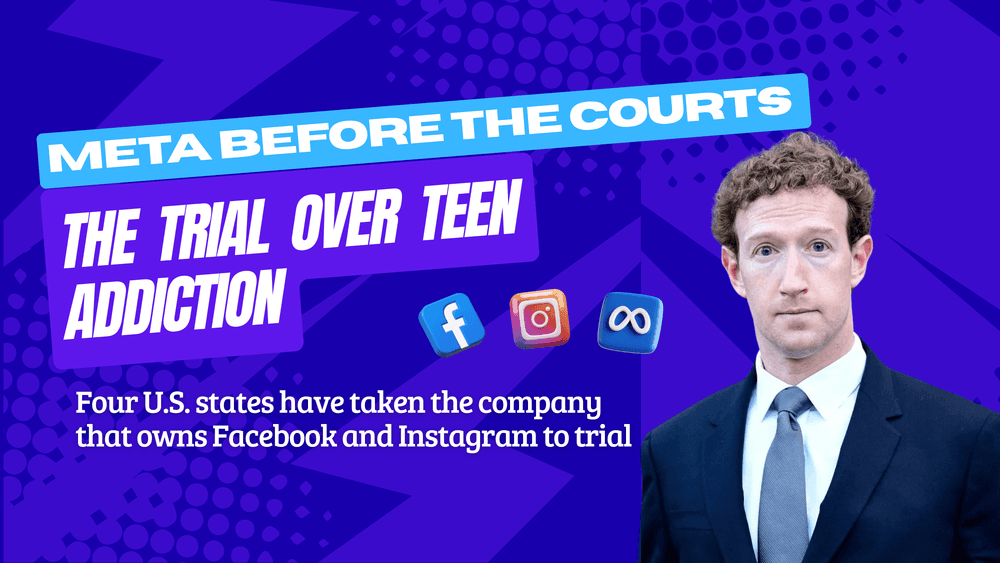
A trial that was expected to last six weeks ended in nine days. Meta and 29 state attorneys general reached a landmark agreement that includes the largest financial penalty ever imposed on a social media company and a set of structural changes to Facebook and Instagram that will affect every minor user in the United States.
How It Ended: A Settlement Nobody Expected This Fast
The federal trial against Meta in Oakland opened on August 18, 2026. It was scheduled to run through early October, with Mark Zuckerberg and Adam Mosseri on the witness list and a jury of eight ready for weeks of expert testimony. Nine days later, it was over.
On August 26, Meta and the coalition of 29 state attorneys general announced a settlement that resolves the cases and claims of 51 states and territories. Judge Yvonne Gonzalez Rogers of the U.S. District Court for the Northern District of California approved it hours after it was filed.
The terms: up to $17 billion paid by Meta over 10 years, and a sweeping set of product changes to Instagram and Facebook that the company must implement within months. California Attorney General Rob Bonta called it "a turning point for youth safety on social media platforms." Meta's chief legal officer, C.J. Mahoney, described the framework as "groundbreaking" and immediately called on TikTok and YouTube to adopt it as well.
What had been the biggest trial in the history of social media litigation became, in the span of a morning, its biggest settlement.
What the Trial Was About
Four states — California, Colorado, Kentucky and New Jersey — were acting as bellwether plaintiffs in a lawsuit filed in October 2023 by 29 attorneys general. Their accusations fell into three blocks.
The first was design oriented toward compulsive use. The states targeted infinite scroll, video autoplay, push notifications, beauty filters and personalized recommendation algorithms, arguing that these product decisions exploit vulnerabilities inherent to adolescent brain development and were adopted while the company knew excessive use was associated with anxiety and depression. California Deputy Attorney General Megan O'Neill summarized the theory in four steps: "Hook the users. Hold them for as long as possible. Harvest their data. Hide the truth."
The second was illegal data collection. The states maintained that Meta allowed children under 13 to access its platforms in violation of the Children's Online Privacy Protection Act (COPPA), and collected and monetized their personal data without parental consent. This was the axis that set the state attorneys general case apart from the thousands of individual lawsuits running in parallel, because state attorneys general can invoke COPPA while private plaintiffs cannot.
The third was deception. The argument was that Meta publicly communicated safety levels and rates of exposure to harmful content that did not match what its own internal research showed.
In a June pretrial ruling, Judge Gonzalez Rogers had already signaled where she stood on the evidence, citing Meta's own documents as supporting the theory that its time-restriction tools were merely a "public relations stunt," because they showed that Meta employees knew spending more time on social media was bad for teens.
Nine Days of Testimony
Week one: the engineer who stayed, and the one who left. The most significant witness of the first week was Arturo Bejar, an engineer who led protection and care teams at the company for six years. Bejar testified that there was a "don't ask, don't tell" approach regarding users under 13, that he personally detected "tens of thousands" of children in that bracket on Instagram, and that within the company this was common knowledge. He described safety tools such as "Take a Break" as "designed to fail," because they required manual activation by the user and could be dismissed with a single tap. He compared that design to an airbag the driver would have to activate themselves every time. Bejar also testified that the company replaced the term "addiction" with "problematic use" in internal communications and that it publicly reported rates of exposure to harmful content of between 0.01 and 0.02 percent, while its own surveys yielded far higher values.
Social psychologist Jean Twenge, of San Diego State University, testified about the relationship between daily social media use and adolescent psychological well-being, citing data showing increases in depression and self-harm indicators between 2010 and 2023. George Volichenko, a former data scientist who joined Instagram's well-being team in 2022 and worked on "take a break" and "quiet mode," testified that he resigned after nine months because of the limited room for action the team was given.
Week two: the Instagram chief under cross-examination. On August 25, the day before the settlement was announced, Adam Mosseri took the stand. He denied directing employees to withhold information: "I'm not trying to encourage my team to hide anything." He acknowledged, however, that the company curbed the number of employees who could access certain internal research after Frances Haugen's 2021 leak of corporate documents, explaining that the policy change was made because "we don't want anything to be taken out of context." The states accused Mosseri of publicly touting the "Take a Break" feature while internal data showed it had very limited uptake by teens.
The following morning, the settlement was announced.
The Terms: Money and Product Changes
Financial. Meta agreed to pay up to $17 billion in penalties to the states over 10 years. A portion of the funds will go toward youth mental health programs, after-school programs and crisis intervention services. Individual states stand to receive defined portions: Michigan at least $171 million, North Carolina $451 million, among others. To put the figure in context, Stanford law professor Nora Freeman Engstrom described the amount as "not exactly pocket change, but it's hardly a body blow" — Meta reported a net profit of around $16 billion in its most recent quarter.
Platform changes for minors. These are the provisions with the broadest reach. Meta must implement, within months:
A default time limit of two hours per day for users under 18, removable only by a parent. If YouTube, TikTok and Snap agree to similar steps under the settlement framework, that default drops to one hour.
A nighttime block between midnight and 6 a.m. for minors, also removable only by a parent.
Default notification blocks during nighttime hours and school hours.
A ban on displaying the number of likes or reactions to posts made by minors.
A ban on cosmetic surgery image filters for users under 18.
An option for young users to access a non-personalized feed not driven by an algorithm targeting them with content.
An independent auditor with expansive access to information and resources and the right to communicate directly with the attorneys general.
An injunction prohibiting Meta from making further false, misleading or deceptive statements about its safety features.
Some provisions are explicitly designed to create competitive pressure on other platforms. The two-hour limit tightens to one hour, and the total financial amount increases, if YouTube, TikTok and Snap join the framework. Meta's chief legal officer made the strategic logic explicit: "Its success depends on all other social media platforms following Meta's lead."
The Road That Led to Oakland
The Oakland trial did not arrive without precedent. It was the third major defeat for Meta in 2026 before the settlement made it the most consequential resolution.
In March 2026, a Los Angeles jury handed down the country's first verdict in a social media addiction case, awarding $6 million to a 20-year-old woman identified as K.G.M. who began using social media at age 6. The jury apportioned liability at 70 percent for Meta and 30 percent for Google's YouTube, and concluded that both platforms were negligent in design, knew the risks and failed to adequately warn users. Mark Zuckerberg testified in that case on February 18, 2026. He was questioned about internal documents estimating in 2015 that 30 percent of children aged 10 to 12 used Instagram, about a 2020 analysis showing 11-year-old users were four times more likely to return to the platform, and about a 2018 internal communication arguing that to win big with teens the company had to bring them in earlier, as tweens. Zuckerberg appeared visibly irritated under cross-examination, responding "You're mischaracterizing what I'm saying" when pressed on the documents. Two jurors later said Zuckerberg's shifting testimony was a factor in deliberations. "He's the guru and he should have known what he was going to say on the stand before he said anything," said one.
Also in March 2026, a New Mexico jury found 75,000 violations of the state's unfair practices act. In August 2026, the judge ordered Meta to contribute an additional 567 million dollars to an abatement fund on top of a 375 million dollar fine, for a total of 942 million dollars, and ordered operational changes for five years including enhanced age verification and time limits for minors. Meta announced it would appeal.
Those two verdicts, plus the internal documents and witness testimony that emerged during Oakland's nine days, formed the backdrop against which both sides decided to settle rather than continue.
What This Settles, and What It Does Not
The agreement resolves the 29-state attorney general action. It does not resolve the thousands of individual and school district lawsuits grouped in MDL 3047, before Judge Gonzalez Rogers in the same court, or JCCP 5255, the California coordination before Judge Carolyn Kuhl in Los Angeles with around 3,300 coordinated cases. Those cases, involving claims from individual families whose children suffered documented harm, continue on their own track.
Matthew P. Bergman, founding attorney at the Social Media Victims Law Center, applauded the settlement as a "watershed moment" but was direct about its limits: "Our work is far from over. We will continue fighting for the individual families whose children will never come home, and for those still struggling with mental health crises caused by these platforms. Accountability to the public is important — but accountability to the families harmed must remain our focus."
Engstrom, the Stanford law professor, offered a broader assessment. Some of the platform changes Meta has agreed to, she said, would have been hard to obtain through legislation. But the settlement sends a signal without being a final verdict: "Meta is clearly signaling that it would like this litigation behind it. But this is not game over."
The comparison to the tobacco settlement of the 1990s, which observers have drawn throughout this litigation, holds in one specific sense: the tobacco cases also did not end in a single verdict. They ended in a framework that reshaped the industry over years. Whether the $17 billion settlement does the same for social media will depend on whether the platform changes Meta has agreed to produce measurable differences for minors, and whether YouTube, TikTok and Snap face enough legal pressure to join the framework or litigate their own way to similar outcomes.
That answer is still being written.
Case Summary
- Court: U.S. District Court for the Northern District of California, Oakland Division
- Judge: Yvonne Gonzalez Rogers
- Plaintiffs: California, Colorado, Kentucky and New Jersey, as bellwether cases in an action by 29 states filed in October 2023
- Defendant: Meta Platforms (Facebook and Instagram)
- Statutes: Children's Online Privacy Protection Act (COPPA) and state consumer protection laws
- Trial dates: August 18-26, 2026
- Settlement amount: Up to $17 billion over 10 years
- States covered by settlement: 51 attorneys general
- Key platform changes: 2-hour default time limit for minors, midnight-6am block, notification restrictions, ban on likes display and surgery filters for minors, non-personalized feed option, independent auditor, injunction on misleading safety claims
- Pending: MDL 3047 and JCCP 5255 individual and school district lawsuits continue
Sources
- NPR. Meta, states agree to $17 billion settlement in child safety trial. August 26, 2026. https://www.npr.org/2026/08/26/nx-s1-5944781/meta-settlement-child-safety-lawsuit
- NPR. 'Profits won.' The child safety trial against Meta kicks off in federal court. August 18, 2026. https://www.npr.org/2026/08/18/nx-s1-5935458/meta-child-safety-social-media-addiction-trial-opening
- NPR. The first week of testimony wraps in the federal child safety case against Meta. August 20, 2026. https://www.npr.org/2026/08/20/nx-s1-5936640/the-first-week-of-testimony-wraps-in-the-federal-child-safety-case-against-meta
- NPR. Whistleblower Arturo Béjar leads testimony in landmark trial against Meta. August 19, 2026. https://www.npr.org/2026/08/19/nx-s1-5936648/meta-trial-arturo-bejar-whistleblower-testimony
- NPR. Instagram head Adam Mosseri testifies in defense of Meta in child safety trial. August 25, 2026. https://www.npr.org/2026/08/25/nx-s1-5944266/adam-mosseri-instagram-meta-child-safety-trial
- CNBC. Instagram chief Mosseri says in social media addiction trial he doesn't tell team to 'hide anything'. August 25, 2026. https://www.cnbc.com/2026/08/25/instagram-adam-mosseri-testifies-california-state-ag-federal-meta.html
- CNBC. Meta faces state AG trial over child safety claims. August 17, 2026. https://www.cnbc.com/2026/08/17/meta-attorneys-general-california-federal-trial-astronomical-consequences.html
- KQED. Meta Faces Up to $1.4 Trillion Reckoning as Youth-Addiction Trial Opens in Oakland. August 18, 2026. https://www.kqed.org/news/12094595/meta-faces-up-to-1-4-trillion-reckoning-as-youth-addiction-trial-opens-in-oakland
- Courthouse News Service. Meta questions psychologist's testimony in teen mental health harms trial. August 24, 2026. https://courthousenews.com/meta-questions-psychologists-testimony-in-teen-mental-health-harms-trial/
- Fortune. Meta faces $1.4 trillion penalty in landmark child-safety trial. August 20, 2026. https://fortune.com/article/meta-faces-1-4-trillion-threat-stakes-of-case-reach-across-tech-08-20-2026/
- Rolling Stone. Mark Zuckerberg Testifies at Landmark Trial on Teen Social-Media Addiction. February 18, 2026. https://ca.rollingstone.com/mark-zuckerberg-testifies-at-landmark-trial-on-teen-social-media-addiction
- NPR. Verdicts against Meta and Google may bring a new era of big tech accountability. April 3, 2026. https://www.npr.org/2026/04/03/nx-s1-5764306/big-tech-lawsuits-verdicts-accountability-social-media-harms
- New Mexico Department of Justice. Court Orders Meta to Pay $942 Million and Overhaul Protections for Children. August 2026. https://nmdoj.gov/press-release/court-orders-meta-to-pay-942-million-and-overhaul-protections-for-children-on-facebook-and-instagram-in-landmark-new-mexico-ruling/
- California Attorney General. Settlement Agreement — MDL Consent Judgment. August 26, 2026. https://oag.ca.gov/system/files/attachments/press-docs/23-05448-ecf-572-1-exhibit-1-mdl-consent-judgment-final-settlment-agreement-fully-executed.pdf
- MDL Update. Status of JCCP 5255 and MDL 3047 litigation. August 2026. https://mdlupdate.com/mdl/3047-social-media-adolescent-addiction/jccp-5255/