
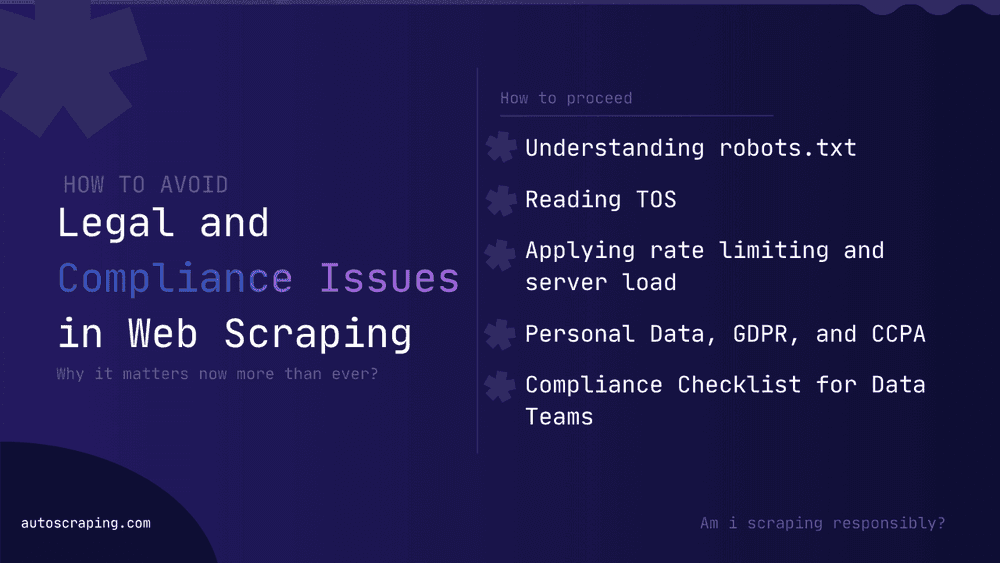
Web scraping is one of the most powerful tools in modern data engineering. It is also one of the most misunderstood from a compliance standpoint. This guide covers what responsible scraping looks like in practice.
Most conversations about web scraping get stuck on the wrong question: "Is web scraping legal?" That framing leads nowhere useful, because the answer is always "it depends." It depends on what data you collect, how you collect it, what you do with it, and where you and your targets are located.
The more productive question is: "Am I scraping responsibly?" And responsible scraping has a clear, actionable definition. It means respecting the technical and legal boundaries that websites, regulators, and users have established. It means collecting only what you need, from sources that permit it, in a way that does not harm the systems or people involved.
This guide walks through the key compliance areas every team doing web data collection should understand, and the practical steps to stay on the right side of all of them.
Why Compliance in Scraping Matters More Than Ever
Data regulators, platform operators, and courts have all become more active on web data collection over the last several years. A few things have changed the landscape significantly:
The enforcement of GDPR in Europe and CCPA in California established that personal data has legal protection regardless of whether it is technically publicly accessible. A data point being visible on a webpage does not automatically make it free to collect and use.
Several high-profile court cases have clarified the boundaries of automated data access. Notable examples include the HiQ vs. LinkedIn case in the U.S., which ruled that scraping publicly available data from LinkedIn did not violate the Computer Fraud and Abuse Act, and various GDPR enforcement actions in Europe where companies were fined for aggregating personal data from public sources without a lawful basis.
At the same time, the business value of web-collected data has grown significantly. Pricing intelligence, competitive monitoring, market research, real estate analytics, financial data aggregation: these are now core use cases for companies of all sizes. The demand for reliable, compliant data pipelines has never been higher.
The combination of higher stakes and more active enforcement makes a working compliance framework not just advisable, but essential.
Start With robots.txt
The robots.txt file is the first place any responsible scraper should look before collecting data from a website. It is a plain-text file hosted at the root of a domain (for example, https://example.com/robots.txt) that specifies which parts of the site automated crawlers are permitted to access.
A typical robots.txt entry looks like this:
User-agent: *
Disallow: /private/
Disallow: /user-data/
Allow: /public/
This tells all crawlers (User-agent: *) to avoid the /private/ and /user-data/ sections, while permitting access to /public/.
What to do in practice:
- Always fetch and parse the robots.txt before initiating any crawl.
- Honor Disallow directives for all paths listed.
- Pay attention to Crawl-delay directives when present; they specify a minimum wait time between requests.
- If there is no robots.txt, that does not mean anything goes. It simply means no explicit instructions were given.
Ignoring robots.txt is not just a legal risk. It is also a reputational one. Responsible crawling behavior is often a factor in whether a website's legal team decides to pursue action against a data collector.
Read the Terms of Service
robots.txt handles technical access permissions. Terms of Service (ToS) handle contractual ones. Many websites include explicit clauses about automated access, data collection, and commercial use of their content.
Common ToS restrictions relevant to scraping include:
- Prohibitions on automated access without prior written consent.
- Restrictions on using collected data for commercial purposes.
- Clauses against creating derivative products from the site's content.
- Requirements to display attribution or source links.
What to do in practice:
- Review the ToS of any target site before building a scraper for it.
- If the ToS explicitly prohibits automated access, do not proceed without contacting the site operator for permission. Many companies offer official data APIs or data licensing agreements for legitimate commercial use cases.
- Document your ToS review as part of your data sourcing process. If a compliance question ever arises, having a record of due diligence matters.
- Note that ToS violations are generally a civil matter, not a criminal one, but they can expose a company to lawsuits and injunctions.
Rate Limiting and Server Load
One of the clearest markers of irresponsible scraping is sending requests at a volume or speed that degrades the performance of the target server. This causes real harm to other users of the site, can constitute a denial-of-service attack under some legal frameworks, and almost always triggers blocks and countermeasures.
Responsible rate limiting is both an ethical standard and a practical one: a scraper that respects the server is a scraper that stays operational.
What to do in practice:
- Add delays between requests. A minimum of one second between requests is a reasonable baseline; more is better for heavily loaded servers.
- Respect the Crawl-delay value in robots.txt if it is specified.
- Avoid running multiple concurrent threads hitting the same domain unless the site explicitly permits it.
- Schedule large collection jobs during off-peak hours when possible (nights and weekends for most commercial sites).
- Implement exponential backoff: if you receive a 429 (Too Many Requests) or 503 response, wait and retry with increasing delays rather than hammering the server.
- Identify your crawler in the User-Agent header. A responsible bot announces itself. Something like "MyCompanyScraper/1.0 ([email protected])" allows site operators to reach you if there is a problem.
Personal Data, GDPR, and CCPA
This is where compliance gets most complex, and where the most significant legal exposure exists for companies doing web data collection.
What counts as personal data
Under GDPR (the General Data Protection Regulation, applicable in the European Union), personal data is any information relating to an identified or identifiable natural person. This includes names, email addresses, phone numbers, physical addresses, IP addresses, location data, and any other identifier that can directly or indirectly single out an individual.
Under CCPA (California Consumer Privacy Act), similar protections apply to California residents.
The critical point: data being publicly visible on a website does not remove its status as personal data. A person's name and employer on a LinkedIn profile is still personal data under GDPR, even if it is publicly accessible. Collecting it, storing it, and processing it without a lawful basis is a regulatory violation.
Lawful bases for processing personal data from web sources
GDPR requires that every collection of personal data has a lawful basis. The most relevant for web scraping contexts are:
- Legitimate interests: You have a genuine business reason to collect the data, and that interest is not overridden by the individual's rights. This is the most commonly cited basis for B2B data collection (e.g., collecting company names and business email addresses for lead generation). It requires a documented legitimate interests assessment.
- Contractual necessity: The data is needed to fulfill a contract with the person.
- Consent: The individual has explicitly consented to their data being collected and used for your specific purpose.
Legitimate interests does not mean "we find this useful." It requires a genuine balancing test between your interest and the impact on the individual's privacy.
What to avoid
- Do not collect personal data at scale without a documented lawful basis.
- Do not collect sensitive categories of personal data from public sources (health information, religious beliefs, political opinions, sexual orientation) without explicit consent. These have higher protection under GDPR.
- Do not use scraped personal data for purposes that the individuals would not reasonably expect. Using a person's public professional profile to send them a targeted email is different from using it in an internal market research report.
- Do not ignore data subject rights requests. If an individual asks you to delete their data, you are required to do so.
Practical compliance steps
- Minimize data collection: only collect the personal data fields you actually need for your use case.
- Establish and document your lawful basis before you start collecting.
- Implement retention policies: do not store personal data indefinitely. Define how long you need it and delete it after that period.
- Maintain records of your data processing activities as required by GDPR Article 30.
When Web Scraping Is Clearly Acceptable
Compliance conversations can make web scraping sound like a minefield. It is worth being clear about the large category of use cases where scraping is straightforward and widely accepted.
Publicly available pricing data. Collecting product prices, availability, and specifications from e-commerce sites is a standard practice in retail intelligence, dynamic pricing, and competitive monitoring. This data is not personal, it is published intentionally for public consumption, and its collection does not harm individuals.
News and public media content. Collecting headlines, publication dates, authors, and article summaries from news sites for media monitoring, sentiment analysis, or trend detection is a well-established practice. Reproduction of full article text raises separate copyright considerations, but metadata collection is generally unproblematic.
Real estate listings. Property listings, prices, locations, and features are publicly published for the purpose of being found and compared. Aggregating this data for market analysis or investment intelligence is standard in the industry.
Business directory information. Company names, addresses, phone numbers, and industry classifications from business directories are published for the purpose of being contacted. Collecting this data for B2B prospecting, market mapping, or company research is a common and generally accepted practice (subject to ToS review of specific directories).
Government and public records. Data published by government agencies, regulatory bodies, courts, and public institutions is explicitly intended for public access. Collecting, organizing, and analyzing it is not just acceptable, it is actively encouraged for transparency and accountability purposes.
Financial market data. Publicly available stock prices, filings, and market data from exchanges and regulatory portals (such as SEC EDGAR) are collected and processed by thousands of companies daily.
The common thread in all of these: the data was published with the intent that it be accessed, does not involve personal data of private individuals, and is being used for purposes consistent with the context in which it was published.
Compliance Checklist for Data Teams
Use this checklist before launching any web scraping project:
Before you start:
- Reviewed robots.txt of the target site and confirmed the target paths are permitted.
- Reviewed Terms of Service for any restrictions on automated access or commercial use.
- Confirmed that an official API or licensed data feed is not available (if it is, prefer that over scraping).
- Identified whether the data to be collected includes personal data under GDPR/CCPA.
- If personal data is involved: documented the lawful basis for collection.
- Defined the minimum data fields needed (data minimization).
Technical configuration:
- Crawler identifies itself with a descriptive User-Agent string including a contact email.
- Delays between requests are configured (minimum 1 second, or as specified by Crawl-delay).
- Exponential backoff is implemented for 429 and 503 responses.
- Concurrent request limits are set appropriately for the target domain.
- No scraping of pages that require authentication or session tokens not legitimately obtained.
Data handling:
- Retention policy is defined: how long will this data be stored?
- Personal data fields are stored securely and access-controlled.
- Process for handling data subject rights requests (deletion, access) is in place.
- Data processing activities are documented per GDPR Article 30 if applicable.
Ongoing:
- robots.txt is re-checked periodically (sites update their policies).
- ToS changes are monitored for target sites used in recurring pipelines.
- Data quality and source availability are reviewed regularly.
How AutoScraping Handles Compliance for You
Building and maintaining a compliance-first scraping infrastructure takes real effort. robots.txt parsing, rate limiting, proxy management, data minimization, GDPR documentation: each of these is a separate engineering and legal concern that has to be kept current as regulations and site policies change.
AutoScraping's Data Factory service handles all of this operationally. Every pipeline we build for clients goes through a compliance review that covers technical access permissions, data classification, rate limiting configuration, and applicable regulatory requirements. We maintain documentation of our data sourcing practices and can provide compliance artifacts to clients who need them for their own regulatory requirements.
If you are building a data pipeline and want to make sure it is on solid compliance ground from day one, we can help.
Talk to our team about a compliant data pipeline
Frequently Asked Questions
Does robots.txt have legal force? robots.txt is a technical standard, not a law. However, ignoring it has been considered relevant evidence in court cases involving unauthorized access. Beyond legal risk, ignoring robots.txt is widely considered a violation of basic professional standards in web data collection.
Can I scrape data that is behind a login? Generally, no. Accessing data behind authentication typically requires agreeing to terms of service, and collecting that data without authorization raises serious legal risks under computer access laws (including the CFAA in the U.S.). There are narrow exceptions for legitimate research contexts, but the default answer is to avoid it.
Is scraping social media profiles permissible? This is one of the most complex areas. Public profiles on social platforms are visible without authentication, but most social media ToS explicitly prohibit automated collection. Additionally, social profile data is almost always personal data under GDPR. Proceed only with careful ToS review, a documented lawful basis, and legal advice if operating at scale.
What is the difference between scraping and using an API? An API is an official data access channel provided by the platform operator. When an API is available, it is always preferable to scraping: it is authorized, stable, and comes with clear terms of use. Scraping is appropriate when no API exists, when the API does not cover the needed data, or when API pricing makes it impractical for the required volume.
How does AutoScraping ensure its pipelines are compliant? Every Data Factory engagement includes a review of the target sources, applicable regulations for the client's jurisdiction and use case, and technical configuration to ensure responsible collection practices. We maintain records of our data sourcing decisions and can provide compliance documentation to clients.
AutoScraping is a data engineering and AI automation company. We build compliant, scalable web data pipelines for companies across e-commerce, real estate, finance, and the public sector. This article is informational and does not constitute legal advice. For specific legal questions about your data collection practices, consult a qualified attorney.
