On November 11, 95% of a Catalog Disappears, and That Demand Has to Go Somewhere
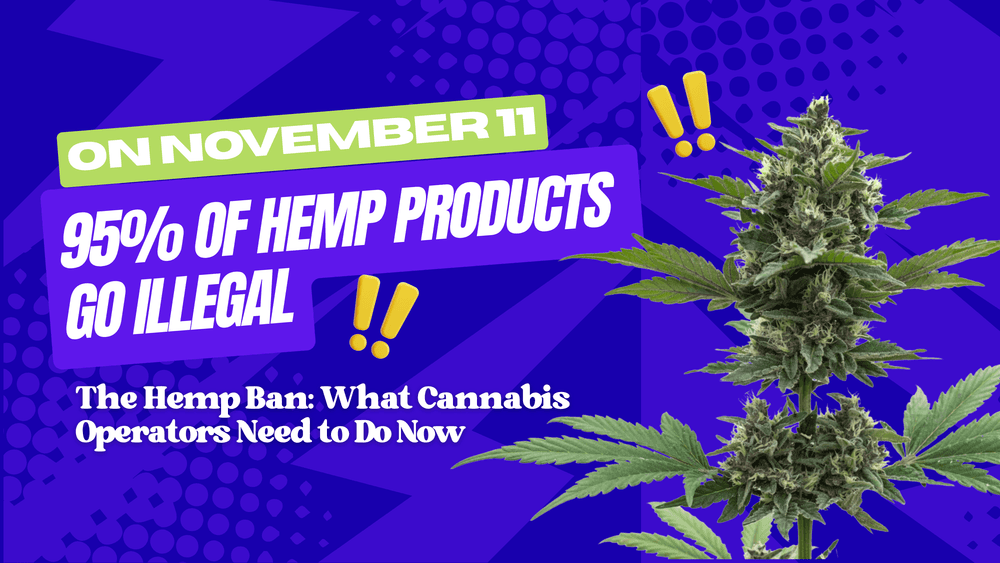
On November 11, 2026, roughly 95% of the intoxicating hemp products currently sold in gas stations, smoke shops and online stores across the United States stop being legal.
The question almost nobody is asking is not what happens to those products. It is what happens to the people who were buying them.
What actually changes
Section 781 of the 2026 appropriations act redefines hemp at the federal level. Two changes, both technical, both devastating for the channel:
First: the 0.3% THC limit is now calculated on total THC on a dry weight basis. Total means THCA and synthesized isomers such as delta-8 are now included in the calculation, when until today they fell outside it. That omission was precisely the opening the entire category was built on.
Second: a finished product ceiling appears, set at 0.4 milligrams of total THC per container. Not per serving: per container.
Four tenths of a milligram per container is a threshold that the overwhelming majority of hemp gummies, beverages and vapes currently on shelves does not come close to meeting. The U.S. Hemp Roundtable estimates the rule reaches roughly 95% of the hemp derived products on the market today.
The reframe: this is not a compliance problem
Almost everything written about this rule treats it as a legal matter. What needs reviewing, what needs pulling, what risk attaches to anyone who does neither.
That framing is correct and also insufficient, because it describes the problem for exactly one party: the hemp seller. It leaves out the party with the most to gain or lose here, which is the licensed cannabis operator.
Seen from the market rather than from the filing cabinet, what happens on November 11 is something else: an entire distribution channel switches off overnight, and its consumers do not disappear with it.
This is probably the largest demand reshuffle of the decade in this industry. And unlike almost every other regulatory shock, this one comes with a date on the calendar.
Where that demand can go
There is no single answer, and that is what makes it interesting. It depends on the state.
In states with a legal adult use market, a good share of that demand has an obvious place to land: the licensed dispensary. The consumer who was buying a delta-8 gummy at a gas station in Ohio or Michigan can buy a regulated gummy ten minutes away. They will pay more, they will have to show ID, and they will find a different product, but the channel exists.
In states with no adult use program, there is nowhere to go. Intoxicating hemp functioned for years as the de facto substitute for legal cannabis across much of the South and the middle of the country. When that channel switches off and no dispensary replaces it, the demand does not evaporate: it migrates to the illicit market or crosses a state line.
For a licensed operator, that distinction is everything. If you have stores in a state of the first kind, November 12 brings you a flow of new shoppers you know nothing about: you do not know which format they preferred, what price they were used to, or what potency they were looking for. If you have stores near a border with a state of the second kind, you get a different flow, with a different profile.
In both cases, the difference between capturing that flow and watching it walk past comes down to one thing: whether you measured what that consumer looked like before their channel disappeared.
What a licensed operator should be measuring right now
There are fewer than three months left. This is what belongs on the table today, not in December.
The hemp catalog selling in your radius. Which products, from which brands, in which formats. Not to report them: to understand what product expectation the shopper walking into your store in November is bringing with them.
That channel's pricing. This is the most underrated data point of them all. Intoxicating hemp competes in a meaningfully lower price band than licensed cannabis, because it pays neither the taxes nor the compliance costs of the regulated channel. The consumer coming from there arrives with a price anchor already formed. If you do not know what it is, you will misprice the entry level product you are counting on to capture them.
Formats and potencies. A shopper used to a 25 mg delta-8 gummy is not looking for the same thing as your regular dispensary customer. Knowing which doses and formats dominated the channel that is switching off is what tells you which SKUs need to be on your shelf on November 12.
And the baseline, which is the urgent part. Everything above stops being measurable the day the channel disappears. After November 11 you will not be able to reconstruct what was selling before, because catalogs get taken down, sites go dark and product pages get deleted. Either you captured it beforehand, or it does not exist.
How to build that map before the date
The work has two halves, and they are worth looking at separately because they get solved differently.
First half: the picture of the before
Extraction of the hemp catalogs currently selling online and within the geographic radius you care about, with brand, format, price and declared THC content.
The hard part is not the catalog: it is the certificates of analysis. The real THC content of these products lives in lab PDFs, hosted across dozens of different brand sites, each in its own format. And every lab reports in a different unit: some in percentage, some in milligrams per gram, some in milligrams per container. Without normalizing everything to a single unit there is no comparison possible, not against the 0.4 mg threshold and not against the product you sell.
This is exactly the kind of work we walked through in How to Scrape and Download Every PDF File from Any Website, with an added layer of parsing and normalization on top.
This is a project with defined scope and a delivery date. That is what DataSquad exists for: senior engineers working inside your team, against a concrete objective, on a deadline. It is not a recurring service. It is a team that comes in, solves it, and leaves the dataset built.
Second half: measuring the after
What actually disappeared from shelves. Which brands reformulated to fit under the new threshold, and with what product. What price gap opened up, and who is filling it. How licensed channel pricing moved in the following weeks.
You will not be able to buy that analysis in time. Industry reports land a quarter behind, and here the decision window is weeks: whoever adjusts assortment and entry pricing first keeps the new shopper, and whoever shows up in February shows up after that shopper has already chosen where to buy.
This is what Data Factory is for: managed recurring extraction, including the architecture, the maintenance when source sites change, the validation, and delivery in the format you already use. Configurable frequency, 99.9% effectiveness and incident response in under one hour, which in a window measured in weeks is the difference between having the data and not having it.
The argument that stings
Standing up an internal team to do this takes longer than the time left before November. Between defining scope, hiring, onboarding and getting a first version running, four months goes by in the best case.
Sources
- Vicente LLP, 2026 Federal Hemp Ban: What It Means for the Future of Consumable Hemp Products
- Cannabis Business Times, House Passes 2026 Farm Bill; Intoxicating Hemp Product Ban Remains
- NPR, An expected end-of-year federal ban puts hemp businesses in jeopardy