Recent studies in data sourcing estimate cost reductions of up to 60% when alternatives to traditional Data as a Service (DaaS) are properly implemented. While DaaS solutions have dominated the market for years, evolving business needs and technological advances are driving companies to explore more flexible, cost-effective approaches to data acquisition and management.
Data as a Service (DaaS)
What is Data as a Service?
Data as a Service (DaaS) is a cloud-based model where data is provided on-demand to customers over the internet. It involves storing, managing, and delivering data through a centralized platform, allowing businesses to access the information they need without investing in extensive infrastructure.
Key Characteristics of DaaS:
- On-Demand Access: Data is available whenever needed, reducing the need for local storage.
- Scalability: Easily scale data usage based on business requirements.
- Cost Efficiency: Pay only for the data you use, eliminating upfront infrastructure costs.
- Centralized Management: Data is stored and managed by the service provider, reducing IT overhead.
- Integration: Seamlessly integrate data into existing applications and workflows.
Benefits of DaaS:
- Reduced Infrastructure Costs: No need for expensive data centers or storage systems.
- Faster Implementation: Quick access to data without lengthy setup processes.
- Data Quality: Access to clean, structured, and validated data.
- Flexibility: Adjust data usage based on changing business needs.
- Focus on Core Business: Let experts handle data management while you focus on strategy.
Limitations of DaaS:
- Recurring Costs: Ongoing subscription fees can add up over time.
- Vendor Lock-In: Dependency on a single provider can limit flexibility.
- Limited Customization: May not meet highly specific or unique data requirements.
- Data Security Concerns: Storing data with third parties raises security and privacy issues.
Understanding Alternatives to Data as a Service
While DaaS offers convenience, it's not always the best fit for every organization. Several alternatives provide different approaches to data acquisition and management:
What is Data as a Service?
Data as a Service delivers data on-demand through cloud platforms, but alternatives offer more control, customization, and cost savings.
Why Consider Alternatives?
- Cost Management: Reduce long-term expenses associated with subscription-based models.
- Greater Control: Maintain full control over data collection, storage, and processing.
- Customization: Tailor solutions to specific business needs.
- Data Ownership: Retain complete ownership of collected data.
- Security: Implement custom security measures aligned with your policies.
Popular Alternatives to Data as a Service
Web Scraping Services
Web scraping involves extracting data directly from websites using automated tools. This approach offers high flexibility and control over data collection.
Key Features:
- Custom data extraction tailored to specific sources
- Real-time or scheduled data collection
- Ability to gather data from multiple websites simultaneously
- Cost-effective for large-scale data needs
Use Cases:
- Price monitoring and competitive analysis
- Market research and trend analysis
- Lead generation and contact information
- Product catalog aggregation
- Review and sentiment analysis
The Solution Is:
- Custom Solutions: Develop in-house scraping tools
- Outsourced Services: Partner with specialized web scraping providers
- Hybrid Approach: Combine internal and external resources
Data Extraction Tools
Self-service data extraction tools allow businesses to extract data without extensive technical knowledge.
Popular Tools:
- Octoparse: User-friendly visual data extraction
- ParseHub: Point-and-click web scraping
- Import.io: Web data integration platform
- Scrapy: Open-source Python framework for advanced users
Benefits:
- Lower costs compared to DaaS
- Greater control over data collection
- Customizable to specific needs
- No vendor lock-in
Automated Data Collection Solutions
Automated solutions combine scraping, data processing, and delivery into comprehensive platforms.
Features:
- Scheduled data collection
- Data cleaning and normalization
- Multiple output formats
- API integration
- Monitoring and alerts
Comparing DaaS with Alternatives
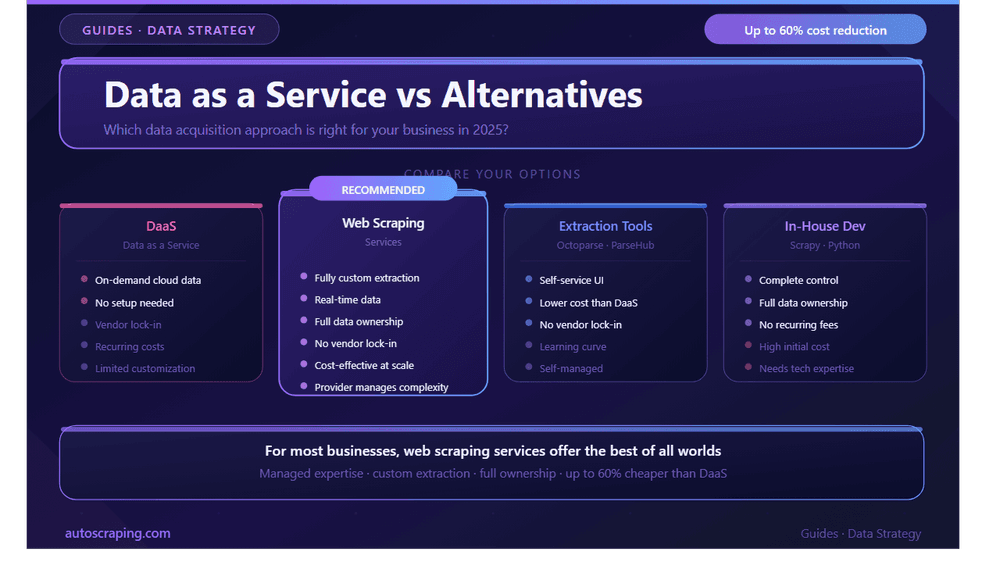
| Aspect | Data as a Service | Web Scraping Services | Data Extraction Tools | In-House Development |
|---|---|---|---|---|
| Cost | Subscription-based | Variable (project-based) | One-time purchase/subscription | High initial, low ongoing |
| Control | Limited | High | High | Complete |
| Customization | Limited | High | Medium | Complete |
| Technical Expertise | Not required | Not required | Basic knowledge needed | Advanced skills required |
| Scalability | High | High | Medium | Depends on infrastructure |
| Maintenance | Provider handles | Provider handles | Self-managed | Self-managed |
| Data Ownership | Shared | Full | Full | Full |
DaaS vs Web Scraping Services
Web scraping services offer several advantages over traditional DaaS:
- Flexibility: Extract data from any publicly available source
- Customization: Tailor extraction to specific data points and formats
- Cost Efficiency: Pay per project or subscription rather than per-data-point
- Real-Time Data: Access up-to-the-minute information
- No Vendor Lock-In: Switch providers or bring operations in-house easily
DaaS vs Data Extraction Tools
Data extraction tools provide a middle ground between DaaS and custom development:
- Lower Cost: One-time purchase or affordable subscriptions
- User Control: Direct control over what data is extracted and how
- Learning Curve: May require initial training but offers long-term benefits
- No Recurring Fees: Many tools offer perpetual licenses
- Customization: Configure extraction rules to match specific needs
DaaS vs In-House Data Collection Solutions
Building in-house capabilities offers maximum control but requires investment:
Advantages:
- Complete data ownership and control
- Custom security and compliance measures
- No recurring subscription costs
- Integration with existing systems
- Proprietary algorithms and processes
Challenges:
- High initial development costs
- Requires technical expertise
- Ongoing maintenance and updates
- Resource-intensive
- Longer implementation time
Which Tool is Better for Your Needs?
Choosing the right approach depends on several factors:
| Your Situation | Recommended Approach |
|---|---|
| Limited technical expertise, need quick access | Data as a Service (DaaS) |
| Budget constraints, moderate data needs | Data Extraction Tools |
| Specific data requirements, regular updates | Web Scraping Services |
| Large-scale operations, unique requirements | In-House Development |
| Varying needs, want flexibility | Hybrid Approach |
Decision Factors:
- Budget: Initial investment vs. ongoing costs
- Technical Capability: Available in-house expertise
- Data Volume: Amount and frequency of data needed
- Customization Needs: How specific are your requirements
- Timeline: How quickly do you need a solution
- Data Sensitivity: Security and compliance requirements
- Scalability: Future growth expectations
Conclusion
While Data as a Service offers convenience and quick implementation, alternatives like web scraping services, data extraction tools, and in-house solutions provide greater control, customization, and often better long-term value. The best choice depends on your specific business needs, technical capabilities, and budget constraints.
For many businesses, web scraping services represent an ideal middle ground—offering the expertise and reliability of a managed service with the flexibility and cost-effectiveness of custom solutions. By carefully evaluating your requirements and exploring available alternatives, you can find the data acquisition approach that best supports your business objectives.