Looking for an efficient way to get data without relying on traditional scraping? We compare APIs, public datasets, browser automation, data providers and AI-assisted extraction: what works, when, and why.
Getting reliable web data at scale, without legal headaches, is one of the most common challenges for companies and technical teams. And almost everyone starts from the same question: is there a way to do it without scraping?
The short answer is yes, there are several. The long answer is the one that matters, because each alternative solves a different problem and none of them replaces all the others.
In this article you'll see why so many teams look for alternatives to web scraping, what the real limitations of each method are, and how to decide which one to use in each case. We'll also cover something that shifted sharply over the last two years: access to web data has become more expensive, more regulated and more restricted. And that changes the whole calculation.
1. Why Look for Alternatives to Web Scraping
Scraping works. But it comes with concrete friction that's worth understanding before you build an entire project on top of it.
- Constant maintenance. Websites change their structure without warning. A minor tweak to the HTML can break a scraper that had been running for months. The real cost of scraping is almost never in building it: it's in keeping it alive.
- Legal gray area. Extracting public data in a logged-off state is, in the United States, generally defensible. But terms of service, intellectual property and privacy regulations like GDPR or CCPA still apply to what data you take and, above all, to what you do with it afterward.
- Unstructured data. Unlike an API, what a scraper returns usually needs cleaning, normalization and validation before it's usable. That work isn't free and it's rarely budgeted for.
- Rising technical barriers. Bot mitigation, device fingerprinting, rate limits and JavaScript challenges are far more sophisticated today than they were three years ago.
None of this invalidates scraping. It simply explains why it's worth looking at the rest of the menu before deciding.
A. Official APIs
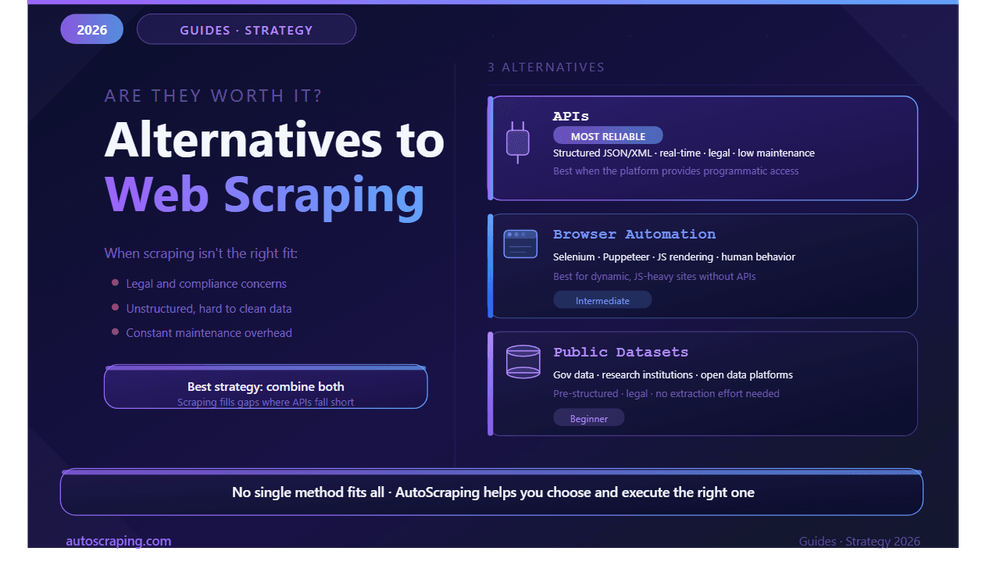
An API gives you a direct connection to a platform's data: you request specific information and receive it already structured, in a clean format like JSON or XML, without having to interpret HTML.
It's the most efficient and least error-prone path whenever it exists. Google, payment platforms, financial providers and much of the SaaS ecosystem offer documented, stable APIs.
Key advantages:
- Structured data, with no need to parse or guess at selectors.
- Real-time updates on the platforms that support them.
- Less maintenance: a versioned API is stable by design; a web layout is not.
- A clear contractual framework: you know what you can do with the data and under what conditions.
The problem: APIs are closing down
Here's the nuance almost no article on the subject mentions. For years, the default recommendation was "use the API if one exists." That advice aged badly.
In 2023 Reddit ended its free API and moved to a paid scheme that priced out a large share of developers. X (formerly Twitter) did the same, and today its access starts at paid tiers with tight quotas. The pattern repeats: the API exists, but its coverage, its quota or its price make it unworkable for the actual use case.
This doesn't mean APIs stopped being the first option. It means that when you evaluate one, asking whether it exists isn't enough. You have to ask what fields it exposes, at what frequency, at what cost and with what limits.
B. Browser Automation
Tools like Playwright, Puppeteer or Selenium drive a real browser and interact with the site the way a person would: they load the page, run the JavaScript, wait for the content to appear and only then read the result.
One honest clarification before moving on: browser automation isn't, strictly speaking, an alternative to scraping. It's a form of scraping. We include it because it solves problems that classic HTTP-request-based scraping can't, but it shares the same legal and maintenance profile.
Where it shines:
- Dynamic sites that build their content entirely with client-side JavaScript.
- Multi-step flows: navigating, filtering, paginating, expanding accordions, infinite scrolling.
- Your own authenticated sessions, such as extracting your own data from a dashboard that offers no export.
Its downsides are just as clear: it consumes far more resources than a simple HTTP request, it's slower and it scales worse. One headless browser per page gets expensive when you're talking about millions of URLs.
And an important limit: using browser automation to evade CAPTCHAs or anti-bot systems isn't an "advantage," it's a risk. It's exactly the ground where the industry's most recent litigation is being fought, as we'll see in the legal section below. Playwright is a tool for reading dynamic content, not a key for forcing locked doors.
C. Public Datasets and Open Data
Public datasets offer data that's already structured and ready to use, with no extraction effort at all. They're usually compiled by governments, international organizations, research institutions or open-data platforms, which makes them reliable and legally unobjectionable.
Sources worth keeping on your radar:
- Government portals: data.gov (US), the EU Open Data Portal, Eurostat, INDEC and their regional equivalents.
- International organizations: the World Bank, the IMF, the OECD, the United Nations.
- Technical repositories: Hugging Face Datasets, Kaggle, Common Crawl.
Benefits:
- Pre-structured data, with far less cleaning work.
- Legal and ethical compliance, since they were published with the explicit intention of being reused.
- High volume at no cost and with no risk of violating terms of service.
Now, the real limitations, the ones enthusiasm tends to cover up: latency (many official datasets are published months or even years behind), granularity (they give you aggregates, not the individual record you need) and above all coverage. No public dataset is going to tell you what your competitor's product costs today. For macro research and market analysis they're excellent; for real-time competitive intelligence, they fall short.
D. Data Providers and Marketplaces (DaaS)
Instead of extracting the data, you buy it ready-made. The Data as a Service model has grown sharply in recent years: specialized providers maintain the infrastructure, absorb the maintenance and deliver an up-to-date dataset via API, feed or scheduled delivery.
In favor:
- Zero maintenance on your side. If the source site changes, that's the provider's problem.
- Contractual framework and compliance delegated, with agreements that define the origin and permitted use of the data.
- Very short time to value: days instead of months.
Against:
- A recurring cost that scales with volume and doesn't drop over time.
- Little customization. The provider defines the schema, the fields and the frequency. If you need a field that isn't there, it isn't there.
- Dependence on a third party for a critical input to your operation.
It's the best option when what you need is a standard, commoditized dataset. It stops being the best option the moment your competitive advantage depends on looking at something nobody else is looking at.
E. AI-Assisted Extraction and Agents
It's the newest category and the one generating the most noise. Instead of writing CSS or XPath selectors, you hand the HTML to a language model along with an output schema and the model returns the JSON. In parallel, browsing agents and the protocols that connect models to tools enable flows where the system decides on its own where to navigate and what to read.
The promise is concrete and real: tolerance to layout changes. If a site redesigns its product page, a rigid selector breaks, but a model that understands the page semantically still finds the price.
The downsides are just as concrete:
- Cost per token. Running millions of pages through an LLM is orders of magnitude more expensive than a deterministic parser.
- Latency far higher than a traditional extraction.
- Hallucinations. A model can invent a missing field instead of returning it empty. Without a validation layer, that contaminates the dataset silently, which is the worst way to contaminate it.
That's why, in practice, what works in 2026 is the hybrid approach: cheap deterministic parsing for whatever is stable and high-volume, and language models only for what's variable, unstructured or constantly changing. AI didn't replace scraping: it took away its most fragile part.
2. API vs Web Scraping: A Direct Comparison
When an API covers what you need, it's almost always the best option. This table sums up why, and also where scraping takes the lead.
| Factor | API | Web Scraping |
|---|---|---|
| Structure | Consistent data in JSON or XML, ready to consume. | Raw data requiring parsing, cleaning and normalization. |
| Reliability | High: accesses the source data without depending on the HTML. | Lower: layout changes break the scripts. |
| Legal framework | Low risk: offered by the data owner, with explicit conditions. | Requires judgment: depends on the type of data, the access and the use. |
| Real time | Usually delivers data instantly or via webhooks. | Depends on how often the process runs. |
| Coverage | Limited to what the platform decides to expose. | Reaches everything a visitor can see. |
| Cost | Increasingly paid, with volume-based quotas. | Low cost per record, high maintenance cost. |
| Complexity | Low: read the documentation and integrate. | High: rendering, pagination, anti-bot, validation. |
The practical conclusion isn't "API good, scraping bad." It's: the API wins when it exists and covers your case; scraping wins when it doesn't. And today, more and more often, it doesn't cover it.
3. When Is Web Scraping Still the Best Option?
The alternatives have clear advantages, but there are scenarios where scraping has no replacement. That's the case when the data isn't available via API, or when the API exists but has restrictive quotas or simply doesn't expose the information that matters.
- Competitive intelligence. No company publishes an API with its prices, its stock or its promotions so the competition can monitor them. This is, by far, the use case where scraping is irreplaceable.
- Scattered data. When the information is spread across hundreds of different sources, each with its own format, scraping is the only thing that unifies it.
- Your own historical series. If you need to know how a price or a catalog evolved over time, you have to start capturing it yourself. Almost no API gives you the past.
- Full market coverage. When you need every player in a sector and not just the three that offer an API.
4. Costs and Timelines: The Honest Comparison
Scraping is often described as the cheap option. That's a half-truth, and the missing half is what sinks projects.
- Initial investment. Setting up an extraction is, in fact, cheaper than negotiating a data contract or waiting for a third party to build an API for you. Here scraping wins.
- Maintenance cost. And here it loses, if it isn't well managed. A scraper isn't a project: it's a living service. It needs monitoring, alerts for structural changes, quality validation and infrastructure. That cost is paid every month, whether or not the site changes.
- Time to data. Once in production, scraping collects large volumes fast, without the per-minute quotas of many APIs. But reaching stable production takes weeks, not minutes.
- The hidden cost: bad data. A scraper that breaks loudly is a good scraper. The expensive one is the one that keeps returning data, but the wrong data, for three weeks before anyone notices.
The right calculation isn't "what does it cost to build," but "what does it cost to sustain for 24 months." Once you run that number, the decision between building in-house and delegating to a specialist tends to flip.
5. The 2026 Context: The Web Is Closing Up
This is the sector's most important shift and the reason the question "alternatives to scraping?" is answered differently today than it was two years ago.
Infrastructure went from open by default to closed by default
In July 2025, Cloudflare became the first internet infrastructure provider to block, by default, AI crawlers that access content without permission or compensation, giving site owners the ability to decide which bots get in and for what purpose.
The escalation continued. As of September 15, 2026, Cloudflare's default configuration will block mixed-use crawlers —those that combine search-engine indexing with model training and agentic use— on any page that displays advertising. The change applies to new customers, new sites belonging to existing customers, and every free account that doesn't opt out before that date.
Cloudflare's argument is in the figures it published for 2025: the ratio between crawls and visits sent back to the source site was roughly 14 to 1 in Google's case, but 1,700 to 1 in OpenAI's. The historic bargain —I let you crawl, you send me traffic— stopped working. In parallel, the company is evolving its pay-per-crawl model into one based on paying for actual use of the content.
The takeaway for any data project is direct: what used to be free because it was public is becoming a resource with a price and with permissions. The barrier is no longer just technical; it's contractual.
The legal map, on one page
It's worth being clear on the precedents, because in practice they define where the line sits:
- hiQ Labs v. LinkedIn and Van Buren v. United States established that accessing public data, without authentication, doesn't constitute "unauthorized access" under the CFAA. Violating terms of service is not a federal crime.
- Meta v. Bright Data (January 2024). Judge Chen dismissed the CFAA claim: Meta's terms govern the use made by someone who is logged in, not logged-off crawling of public content. Meta dropped the case shortly afterward.
- But the breach-of-contract claim partially survived, and only because Bright Data had a prior contractual relationship with Meta. The CFAA shield doesn't cover civil contract claims or state torts.
- Reddit v. Perplexity and others (since late 2025). The axis shifted. The central claim invokes Section 1201 of the DMCA over the circumvention of technical measures —rate limits and anti-bot systems—. The question is no longer "was the data public?" but "did you break a protection to reach it, and what did you do with it afterward?". As of this writing, it's still pending.
Add GDPR and CCPA for personal data, and the European AI Act for model training, and the picture is clear.
The lowest-risk profile in 2026 is consistent: public factual data, no circumvention of access controls, reasonable rate limits, compliance with applicable privacy rules, and a legitimate, non-harmful use. It isn't a gray area: it's a fairly sharp line, and it's on the right side of it.
6. Can the Methods Be Combined?
Not only can they be: it's what the teams that work best with data actually do. No single method covers everything, and forcing just one for the sake of architectural tidiness is an expensive decision.
| Strategy | How it works | Benefit |
|---|---|---|
| Hybrid approach | API where one exists, scraping where it doesn't reach. | Full coverage with the lowest possible maintenance. |
| Optimized workflows | Scraping for the initial bulk load; API for incremental updates. | Fresh data without reprocessing everything each time. |
| Cross-validation | Contrast the scraped data against a public dataset or an official source. | Catches silent errors before they reach the analysis. |
| Layered enrichment | Your own base + purchased data + open sources on the same identifier. | A far more complete view than any isolated source. |
| Parsing + AI | Selectors for what's stable; language models for what's variable. | Resilience to layout changes without the cost of running everything through an LLM. |
7. How to Choose in 60 Seconds
A practical decision tree, in order:
- Is there an official API that exposes the fields you need, at the frequency and volume you need, at a reasonable cost? If the answer is yes to all of it, use the API. Done.
- Is it macro, aggregated or historical data, and does it work for you with a few months' delay? Look in public datasets first, before building anything.
- Is it a standard dataset someone already sells, and not your competitive differentiator? Buying it is probably cheaper than sustaining it.
- Do you need public, specific, up-to-date data that no API exposes? That's scraping territory, and there's no substitute.
- Do you have to log in, pay a wall or break a CAPTCHA to reach the data? Stop. That's the ground where lawsuits are lost. Find another source or negotiate access.
8. Why Choose Autoscraping
All of the above leads to the same practical conclusion: the problem with scraping was never building it; it was sustaining it in an environment that gets more restrictive, more regulated and more technically difficult every year.
That's where we come in:
- Managed extraction, not software you have to maintain. We don't hand you a tool for you to look after. We take care of the infrastructure, the monitoring and the structural changes. You get the data.
- Verified quality, not blind volume. A dataset with silent errors is worse than no dataset at all. We validate before delivering, because bad data costs more than missing data.
- Real scale. From one-off competitor monitoring to pipelines with millions of records. The architecture adapts to the volume, not the other way around.
- Judgment in the approach. If your case is better solved with an API or a public dataset, we'll tell you. Our job is for you to have the right data, not to sell it to you in the most complicated way possible.
We work with companies in the United States, Europe and LATAM from Santiago del Estero, Argentina. We turn the web into your competitive advantage.